
Rush County Court Records After Arrest
Rush County criminal cases move from arrest and booking into court when the prosecutor files charges and the clerk indexes the case. The Rush County Prosecutor's Office criminal division prosecutes felony, misdemeanor, juvenile, and infraction cases in the county. The prosecutor page also says defendants should not expect to speak with the prosecutor or staff before initial hearing. That local note matters because families often call the prosecutor before a case has reached its first court step.
The jail side answers whether a person is currently booked, released, transported, or held. That local custody side runs through the Rush County Sheriff's Office and Jail, whose official page lists Sheriff Allan Rice. The court side answers what charge was filed, what court has the case, what bond or warrant entry appears, and whether the charge is pending, amended, dismissed, diverted, or disposed. For booking and custody fields, use Rush County jail inmate records. For booking photos, use Rush County jail mugshots.
Find Rush County Court Records
The main public court search is Indiana MyCase. Search by defendant name and narrow to Rush County when the portal allows it. If the case number is known, use it because it avoids common-name false matches. A new booking can happen before the court case appears online, so a missing result does not prove there was no arrest. It may mean the case is new, nonpublic, juvenile, sealed, older, filed under a different name, or filed in another county.
The Indiana MyCase landing page is the public entry point for court records after a jail arrest in Rush County.
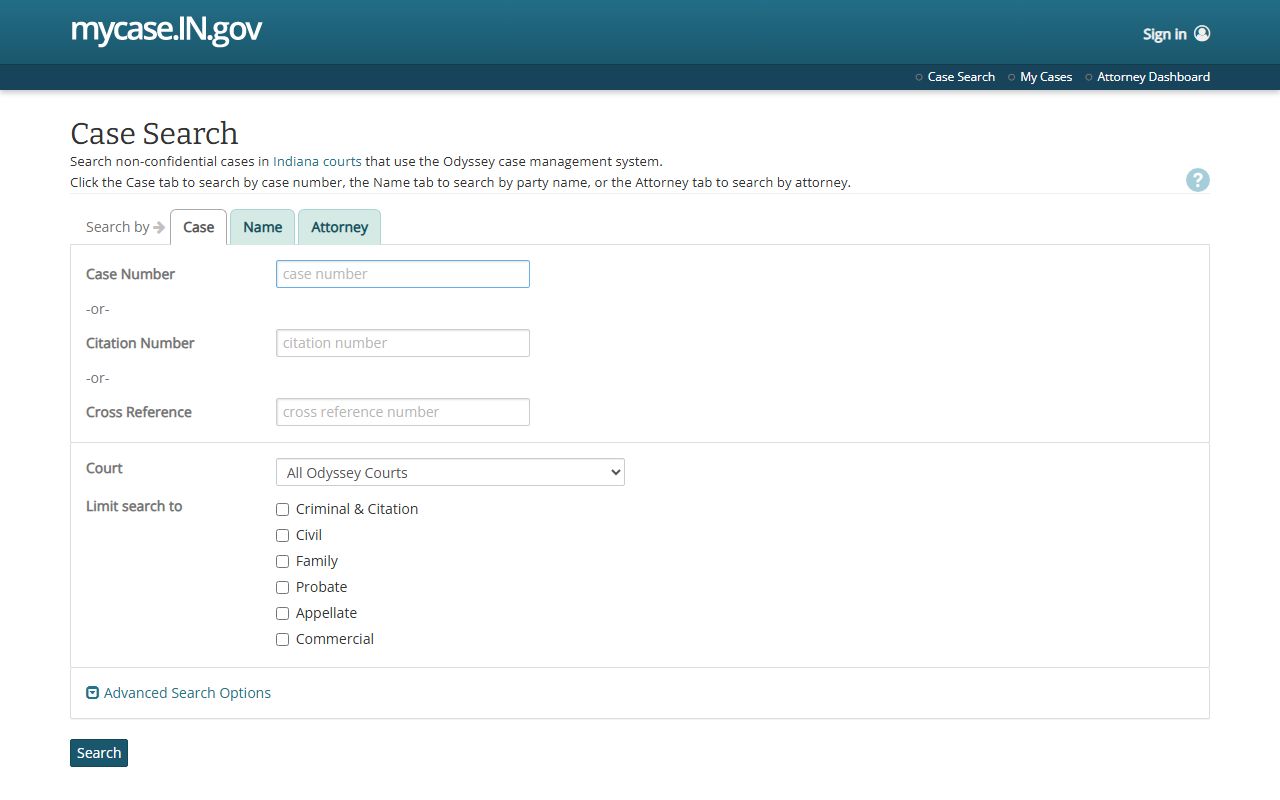
MyCase is the search path for filed court cases, while jail custody questions still belong with the Rush County Sheriff's Office.
- Search MyCase by defendant or party name, then narrow to Rush County if filters are available.
- Use the exact case number when it is known from a bond paper, citation, warrant, or clerk notice.
- Open the criminal case and review the charge list, court, filed date, and parties.
- Read the Chronological Case Summary for hearings, bond entries, warrants, notices, and dispositions.
- Contact the Rush County Clerk if the case is missing, too new, older, sealed, or not public online.
Rush County Court Search Fields
MyCase searches work best when the search is narrow. A statewide name search can return unrelated cases from other counties. Rush County court records after an arrest are more reliable when the user combines name, county, case number, citation number, and date clues from the jail or bond paperwork.
| Field Label | Type | Use | Rush County Note |
|---|---|---|---|
| Case Number | Text | Exact case lookup | Best option when a clerk or court notice lists it. |
| Citation Number | Text | Traffic or infraction cases | Useful for citation-based cases. |
| Defendant / Party Name | Text | Name search | Add county and date clues to reduce false matches. |
| Business Name | Text | Business party cases | Used only when the party is a business. |
| Attorney | Text | Attorney-related search | May help when counsel is known. |
| Court / County | Dropdown or filter | Jurisdiction filter | Select Rush County when available. |
Rush County Clerk Records
The Rush County Clerk is a key office for court records after a jail arrest. The official clerk page says Clerk Jenny Sammons administers court records for all county cases, prepares permanent historical records, processes documents, maintains the Chronological Case Summary, and handles criminal documents such as arrest warrants, change, release, and forfeiture of bond forms, bondsman ordered to produce notifications, and transport orders. The clerk also registers bail agents and collects fees and fines for certain criminal, misdemeanor, infraction, deferral, diversion, extradition, and restitution matters.
The Rush County Clerk page lists the courthouse contact and warns that not all cases may be found online depending on age and whether the case is a matter of public record.

The clerk is the local fallback when the public court portal does not show the record or when copies are needed from the official court file.
Rush County Clerk
101 East Second Street, Room 209
Rushville, IN 46173
765-932-2086
Fax: 765-932-4165
Email listed for office contact: clerk@rushcounty.in.gov
Rush County Arrest Charges
A booking charge is not the same as a court charge. Booking charges reflect what law enforcement alleges at intake. Court charges are the formal allegations filed by the prosecutor and accepted into the court record. The Rush County Prosecutor, Philip J. Caviness, handles the local prosecution role from the courthouse. Once filed, a case may appear in Rush Circuit Court or Rush Superior Court, both of which state that they have criminal and civil jurisdiction for cases originating in Rush County.
The charging document explains the legal basis for the court case. It may use one of several forms, and the public case record may show charge level, offense description, filed date, hearings, bond entries, and later dispositions.
| Document | Meaning | Rush County Context |
|---|---|---|
| Complaint | A formal court filing that states the alleged offense. | May be used in criminal case filing after arrest. |
| Information | A prosecutor-filed charging document. | Common in felony and misdemeanor prosecution. |
| Indictment | A grand-jury charging document. | Less common but possible in criminal practice. |
Rush County Charge Status
Charge status can change as the case moves through court. A person may be arrested on one allegation, charged with another, and later have the case amended, reduced, dismissed, diverted, or resolved by plea, trial, or other disposition. The Chronological Case Summary is important because it shows the sequence of court events, not just the first charge line.
| Status | Plain Meaning |
|---|---|
| Pending | The charge is open and has not reached final disposition. |
| Amended / Reduced | The prosecutor or court changed the charge or level. |
| Dismissed | The charge ended without conviction on that count. |
| Diversion | A program may lead to dismissal if conditions are met. |
| Disposed | The court has entered an outcome, sentence, dismissal, or other final event. |
Rush County Bond Records
Bond records after a jail arrest can appear in several places. The jail can confirm custody and whether a local bond, hold, or no-bond status affects release. MyCase may show bond orders and later changes once the court record is indexed. The clerk handles court documents tied to bond, including change, release, and forfeiture forms, and registers bail agents. The county clerk page also referenced a revised bail and conditions order effective August 25, 2025, but the research did not capture the order text, so no specific Rush bond amounts should be stated.
Call the jail before arriving with payment because the research did not locate accepted methods, after-hours rules, kiosk details, or vendor fees. A hold from another county, IDOC, parole, probation, federal court, USMS, or ICE can prevent release even after one bond is paid.
| Bond Type | Meaning |
|---|---|
| Cash Bond | Money paid as ordered by the court. |
| Surety Bond | A licensed bail agent posts surety under Indiana rules. |
| PR / Own Recognizance | Release on a promise to appear and follow conditions. |
| No-Bond Hold | Payment will not release the person because of a warrant, court order, or hold. |
Rush County Warrant Records
No official Rush County sheriff warrant-search database was located in the reviewed county pages. Warrant information may appear through MyCase if it is tied to a public case event. The clerk page is also relevant because it lists arrest warrants and transport orders among criminal documents the office processes. The sheriff can explain custody and warrant-handling procedures, but the office may not give legal advice or guarantee that calling will avoid arrest.
Common warrant types include arrest warrants for new or existing charges, bench warrants for failure to appear or court-order violations, search warrants that do not function as custody lookups, and fugitive or hold entries from another jurisdiction. Once a warrant is served, a person may be booked into the Rush County jail, and the court record may later show warrant issued, served, recalled, quashed, or bond-related entries.
Rush County Charge vs Conviction
An arrest and a charge are not proof of guilt. A conviction occurs only after a guilty plea, guilty verdict, or other court finding that results in conviction. This distinction matters for court records after a jail arrest because public searches may show allegations long before a case is resolved. Some charges are dismissed, reduced, diverted, or acquitted.
| Record Term | What It Means | What It Does Not Mean |
|---|---|---|
| Arrest | A person was taken into custody. | It does not prove the formal charge or outcome. |
| Charge | The prosecutor filed an allegation in court. | It is not a conviction by itself. |
| Conviction | The court entered a guilty outcome. | It does not describe the whole arrest history. |
| Dismissal | A charge ended without conviction. | It may still require expungement to limit public access. |
Rush County Sealed Arrest Records
Indiana expungement and sealing rules appear in Indiana Code 35-38-9. The research identified provisions for expunging arrest records and broader sealing or expungement of conviction and arrest records. Eligibility depends on the result, timing, offense, prior history, and court order. A dismissal or acquittal does not mean every public copy disappears without the required legal process.
| Topic | Sealed | Expunged |
|---|---|---|
| Basic effect | Public access may be limited by court order. | Access may be restricted under Indiana expungement law. |
| Eligibility | Depends on record type and statute. | Depends on outcome, waiting period, and offense. |
| Where to ask | Rush County court/clerk or legal counsel. | Rush County court/clerk or legal counsel. |
Note: Court staff can provide records procedures, but legal advice about sealing or expungement should come from a licensed attorney.
Restricted Court Records After Arrest
Indiana public records law allows access to many records, but it also protects some records from full public release. Juvenile matters, sealed cases, confidential records, certain investigatory law-enforcement records, medical information, victim or witness details, and security-sensitive information may be withheld or redacted. The clerk's warning that not all cases are online should be taken seriously.
For statewide criminal-history or background-check use, do not treat casual court and jail searches as a consumer report. The Fair Credit Reporting Act restricts employment, credit, tenant, insurance, and similar uses of consumer information. Official court records should be verified at the source before any serious decision.
Important: Rush County Inmate Population is not a consumer reporting agency and cannot be used for FCRA-covered screening decisions.
Public Record Search
Sponsored Results